University of Mississippi College of Liberal Arts Awards Teaching
Applauds educators in English, history, modern languages, and Southern Studies
OXFORD, Miss. – The annual University of Mississippi College of Liberal Arts faculty teaching awards celebrate excellence of class instruction, intellectual stimulation of students, and concern for students’ welfare.
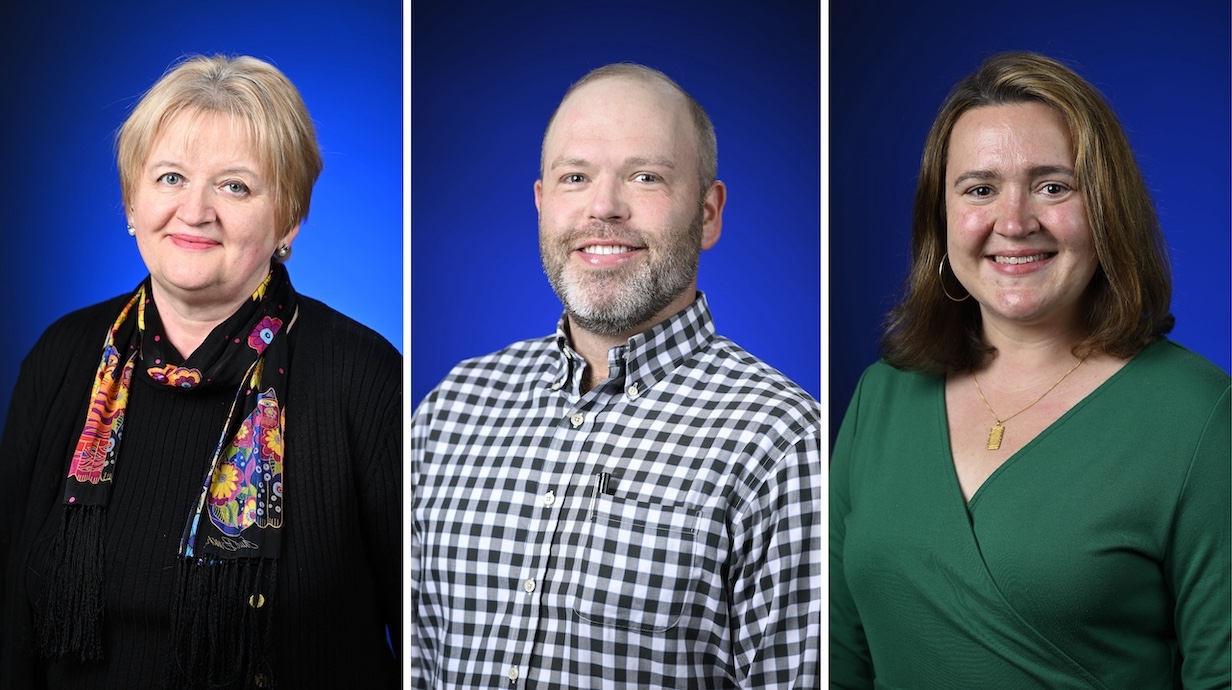
Selected for 2026 teaching honors from the College’s 582 dedicated teachers and mentors are Alexandra Lindgren-Gibson, an associate professor of history, as the Howell Family Outstanding Teacher of the Year; Valentina Iepuri, an associate professor of Russian in the Department of Modern Languages and director of the Russian language program, who will be the Cora Lee Graham Outstanding Teacher of First-Year Students (tenure-track); and Eric Solomon, an instructor of English and Southern Studies, who will receive the Cora Lee Graham Award for Outstanding Teaching of First-Year Students (instructional faculty).
Donald Dyer, associate dean for faculty and academic affairs and distinguished professor of modern languages, commented on this year’s recipients: “The College of Liberal Arts is extremely proud of its newest teaching award winners. Lindgren-Gibson, Iepuri, and Solomon represent the best the College has to offer in the classroom. From history to Russian language, from English to Southern Studies, this group of faculty brings many years of teaching excellence and student advocacy into play, showing us all how to deliver a pedagogical product which means the most for their students.”
Invitation to History
The author of Working-Class Raj: Colonialism and the Making of Class in British India (Cambridge University Press), Lindgren-Gibson brings “energy, intellectual range, and genuine joy” to her courses on modern European history, British history, gender history, public history, historiography, and the global history of food a colleague said. Students “routinely describe working with her as transformative,” said Becky Marchiel, an associate professor of history.
Lindgren-Gibson is committed to innovative course design. “What truly distinguishes Alex is the way she invites students to do history,” said Marchiel. “She builds assignments that push learning beyond the classroom: digital exhibits, community-based public history projects, podcasts, oral histories, and collaborative research initiatives.”
Students in Lindgren-Gibson’s public history and food history courses developed websites on the history of Neilson’s Department Store in Oxford and food blogs featuring family recipes. Her History on Location students worked with the M Partner community engagement program, a place-based initiative of the university’s Grisham-McLean Institute for Public Service and Community Engagement, to develop a walking and driving tour for renowned artist M B Mayfield’s museum and cultural center in Ecru.
Lindgren-Gibson’s What Is History? seminar course offers “sustained, collective engagement with a single text each week,” Marchiel said. “Her War in Ukraine version demonstrated how historical thinking equips students to grapple with urgent contemporary questions through analysis of various texts including fiction, journalism, poetry, and scholarly history. The course gave the entire department a new vehicle to engage students who want to take an intro to history, but don’t want to enroll in the big survey class.”
“The What Is History? course I developed is aimed at giving students in intro level classes the chance to concentrate deeply on one topic in the way they would in an upper division class, but at an accessible level,” Lindgren-Gibson said. “I taught the Ukraine one in response to the war, but other colleagues have taught on all kinds of different topics (including pirates!).”
Bringing Language to Life
Iepuri’s research interests include Russian language in the post-Soviet period, languages in contact, and language pedagogy. She coordinates and teaches courses from beginner to advanced levels and advises students on study abroad programs to enhance their language learning in Russian-speaking countries.
“In and out of the classroom, Dr. Iepuri is a superior teacher and mentor,” said Felice Anne Coles, professor of modern languages. “Her expertise in teaching is shown every day.
“She uses listening comprehension tasks from her own speaking, from PowerPoint presentations, and from cultural artifacts that she brings for students to observe and manipulate. She invites students to speak as they complete a variety of exercises, games, and interactions. She asks students to produce answers to open-ended questions after they have practiced independently, with their peers, with her teaching assistants, and with her in many real-world situations that she has meticulously designed for maximum effectiveness. She encourages students to study all aspects of Russian.”
A former Fulbright and Swedish Institute fellow recognized with prizes from the Central Association of Russian Teachers of America and Mississippi Foreign Language Association, Iepuri directs undergraduate theses about Russian. She also directs and serves on masters’ and PhD student committees for translation studies.
“Her classroom becomes a place where students feel seen, encouraged, and safe to grow,” one student said. “She creates an environment where belonging is just as important as understanding, and where connection is as valued as knowledge. What makes her teaching especially unforgettable is the way she brings the Russian language to life. Through lessons woven with history, art, music, and the soul of the Russian people, she transforms vocabulary and grammar into something living and deeply human. She teaches us not only how to speak Russian, but how to feel it, its humor, its melancholy, its resilience, its warmth.
“Each class feels like a small journey across a vast country I have never physically visited yet somehow leave feeling as though I have walked its streets, heard its stories, and met its people. She gives us the gift of experiencing a culture from the inside out, making the language real, textured, and profoundly meaningful.”
Iepuri engages students in extracurricular activities––supervising Russian Club meetings with guest speakers on many subjects, staffing information tables at the Modern Languages Trivia Night and the World Fest at the Residential College, promoting Russian to the university. “Her ability shines through these activities as she educates newcomers about Russian in innovative situations,” Coles said.
Transformative Teaching
Solomon (BA English 09), who has a doctorate in English from Emory University, has work published in Southern Cultures, Southern Spaces, south, South Atlantic Review, Studies in the Literary Imagination, Mississippi Quarterly, and the North Carolina Literary Review.
“Since returning to UM, Eric has taught hundreds of undergraduate students, from freshmen through seniors,” a colleague said.
He teaches English 224, the survey of US literature since the Civil War, every semester. “This course is part of the general education curriculum, and Eric has consistently had high enrollments and overloads in it. Moreover, students frequently mention his courses as transformative for them. Student satisfaction and transformation are reflected in the high-quality reviews Eric receives in his student evaluations every semester.”
Solomon also teaches upper-level English seminar courses. As a joint appointment with Southern Studies, he has taught freshmen in Southern Studies 107, an introduction to gender and sexuality course. “Students want to take classes with Dr. Solomon. He is a vital addition to our campus community.”
One student said that, “Dr. Solomon showed us how intersectionality applied through the time period with the authors and in the readings as much as in today’s time. It is a key component for our learning inside the lecture hall as well as outside of it as we grow to understand ourselves and the world better.
“Dr. Solomon’s teaching and support . . . will without a doubt have a lasting impression and a positive reflection for the University of Mississippi for many years to come.”
From Leland in the Mississippi Delta, Solomon “is always looking for ways to give back to his native state,” his colleague said. “Though he does that in many ways, he also does it through his teaching, through his profession. For example, Eric has taught with the university’s Prison-to-College-Pipeline Program at Parchman in what he described as one of the most impactful pedagogical experiences of his career thus far.”
Solomon commented, “I am humbled and grateful for this encouragement to keep doing what I love. This recognition has allowed me to look up from my day-to-day and reflect on why I value learning with students so much. As my good friend Kermit says, ‘Take a look above you, discover the view. If you haven’t noticed, please do, please do.’”
The three faculty award recipients are recognized during the College of Liberal Arts annual awards and commencement ceremonies, have their names added to award plaques in the Dean’s office, and each receives $1,000.
Top: Valentina Iepuri, an associate professor of Russian in the Department of Modern Languages and director of the Russian language program (left); Eric Solomon, an instructor of English and Southern Studies; and Alexandra Lindgren-Gibson, an associate professor of history (right).
By
Staff Report
Campus
Office, Department or Center
Published
April 21, 2026